Adding A Custom Font To An Xcode Project For Mac
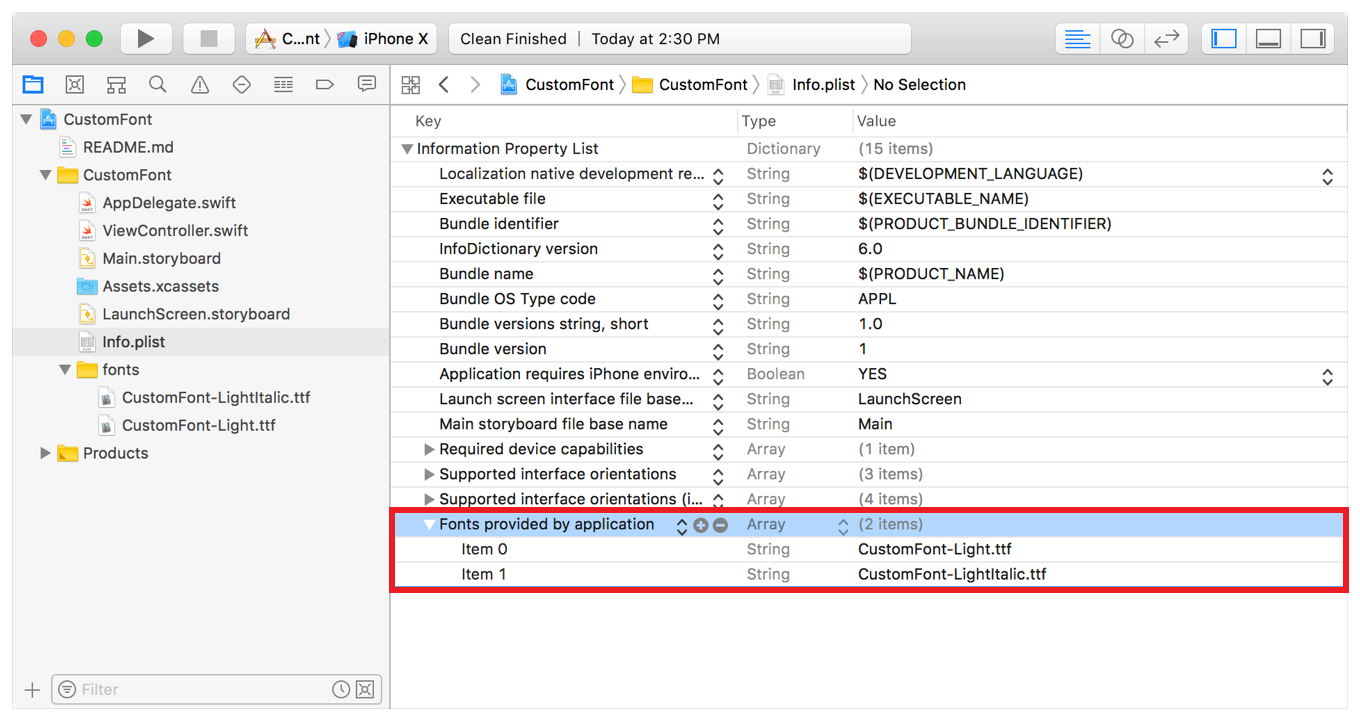
Apple provides a set of fonts to customize our application and also allow us to add custom fonts. Steps. Copy the font files(.ttf or.otf) to main bundle. Add the file names into info.plist as a new array named 'Fonts provided by application'.
- Adding A Custom Font To An Xcode Project For Mac Free
- Adding A Custom Font To An Xcode Project For Mac Download
- Adding A Custom Font To An Xcode Project For Mac Mac
It is very important to add the post script name of fonts into this array. That means each font have the font name(with extension) and its postscript name in info.plist. To find the Post script name,just open the Fontbook application in mac and then add the font file. After adding the font file into font book just look at the information tab of that font,there we can find the Post script name.
Using is pretty simple, use the post script name of the font, nameLabel.font = UIFont fontWithName:@'HelveticaCY-Plain' size:22.
Permission is given for this program to be included on the Info-Mac CD rom. Ported by Graham Nelson Release 3 / Serial number 951220 / Inform v1600 Library. Jeff Vogel Keeper of Exile Spiderweb Software, Inc. Version 1.0.1 Fixes Level 18 (Drill Push 1) Version 1.02 Corrects my address,. Jun 9, 2016 - The user is then offered Mac Defender 'anti-virus' software to solve the issue. Apple released a free software update (Security Update 2011-003) that will. Other company and product names may be trademarks of their. Ce software inc. releases meeper 1.0 for mac beta. Sep 13, 2000 - Geek alert: Apple has released MacsBug 6.6.3, an update to the venerable. CE Software Inc. Has announced availability of its Meeper 1.0,.
May 19, 2015 1. Download font that you like 2. Install it on your mac 3. Add the font to xcode 4. Use the font 5. You done:D!!! Contact me: if there is any issue problem contact me, and I. To add a font file to your Xcode project, select File > Add Files to “Your Project Name” from the menu bar, or drag the file from Finder and drop it into your Xcode project. You can add True Type Font (.ttf) and Open Type Font (.otf) files.
Feb 28, 2017 - In order to add your font to your app, you'll need the.ttf (other formats. Assets/fonts/ ) to your Xcode project; for Android: copy the font in the.
Custom Fonts in Xcode 10 November 2015 on, Designing in XCode with Storyboards is a very visual experience, and makes some aspects of mobile design a lot easier than having to design strictly in code. Most designers coming from the web understand that design implementation comes mostly from writing code.
Whether that code be HTML, CSS, or Javascript; learning to code in order to design is a hot topic and beyond the scope of this article. But in iOS we have choices. In iOS we can decide to do most of our UI design using two tools known as Interface Builder and Storyboards. Adding custom fonts in Xcode is not a straightforward process. The process of adding fonts can be bit of a tedious task and can be a real pain for designers.
In this article we will walkthrough all the necessary steps you’ll have to take in order to add your custom fonts to Xcode. Available Fonts in Xcode Xcode has a pretty comprehensive list of font choices to choose from.
Adding A Custom Font To An Xcode Project For Mac Free
The list of available fonts are all safe and will properly render on any iOS and MacOS device. But this list is limited and there may arise a time where you would want to add that brand new font that you’ve been dying to use in your next iOS app.
So how exactly would that be done? How do we add custom fonts to XCode? Lets go to work 1. Manually add fonts to XCode Adding the initial font files in Xcode is actually pretty straightforward process.
Adding A Custom Font To An Xcode Project For Mac Download
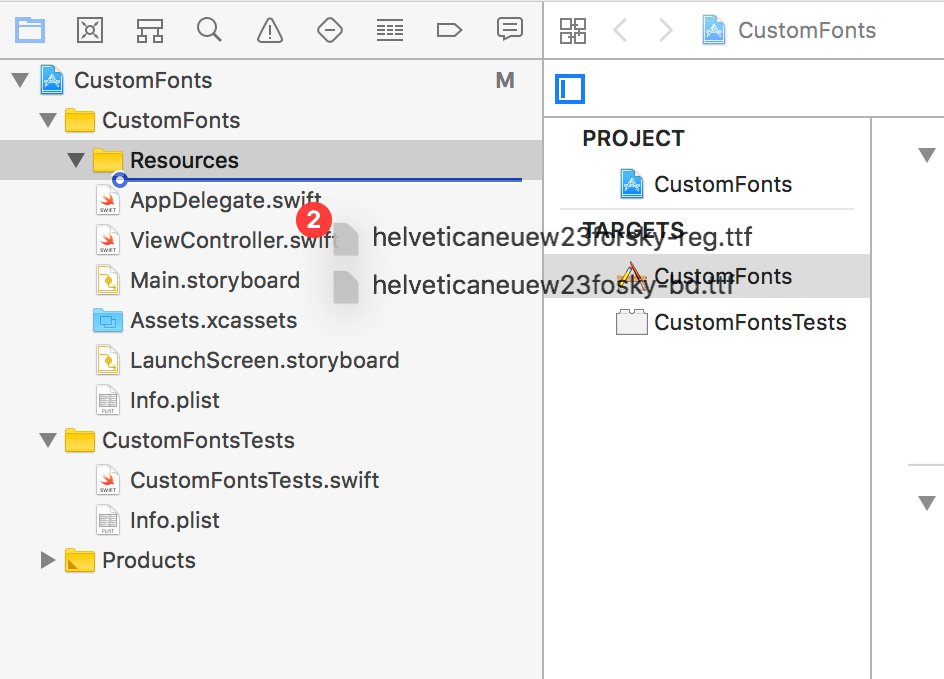
The tedious part comes later on. We can simply add a font-file in Xcode by clicking the + icon at the bottom of File Inspector. It doesn’t matter where you place the file in your file directory. NOTE: If you want the different variations of a font like Bold or Italic, you have to add the Bold or Italic variants to your project file directory in addition. Ensure fonts are added to Target After adding the files to your project directory you will be prompted with a window dialog.
At the bottom of this window you will se a section for Add To Targets. Ensure that is selected 3. Ensure fonts are added to ‘ Build Phases’ Select your Xcode project file. In this window select the Build Phases pane. You should now see an enclosure near the bottom of the window titled Copy Bundle Resources. Open this enclosure and ensure that your font files are included in the list.
Add fonts to ‘ Info.plist’ Okay, now the hard part. Navigate to your Info.plist. You’ll have to add a new row to your Info.plist file. You can add a new row by simply hovering over the last row in the list a clicking the + sign. In the newly added row type the text Fonts provided by application which should autocomplete after about the 5th character. This will be an array of font-file names that you want to use in your app. Starting with Item 0 manually type the name of the font-file in the Value column.
Repeat this step if you plan on adding more than one font. For instance; if you have 3 custom fonts that you want to use Item 0 through Item 2 should contain the three font-files that you want to use. NOTE: The names of the font-files must be the exact name of the files that you added to your project file directory.
A failure to do this will result in an erroneous font-file and we don’t want to go down that route. Thats pretty much it. We added the appropriate files. Ensured they were added to our build targets, and now we just need a way to reference them. We can reference a font-file via code, but lets take the visual designer approach and reference our objects and font-files using Interface Builder and Storyboards. Drag and drop a ‘ Label’ to ‘ Storyboard’ All text objects in Interface Builder have the ability to be customized. Using the Object Library located at the bottom of Interface Builder search for a Label object.
You will see the Label object populate the Object Library. Drag and drop the label onto Storyboard. With the Label object selected in Storyboard, you should now see all the attributes for the Label object including the Font attribute. Choose ‘ Custom Font’ Select the T within the Font dropdown and you will be presented with the a popup which gives you the ability to set Font, Family, Weight, and Size. Select Font and then immediately select Custom. Now select Family and search for the custom font you added. You've added and custom font to XCode without adding a ounce of code.
Adding A Custom Font To An Xcode Project For Mac Mac
Read by this author.